
What Are Causes of High Frequency Trading Front-Running Stocks?
List of 5 Includes Retail Trader Cluster Orders
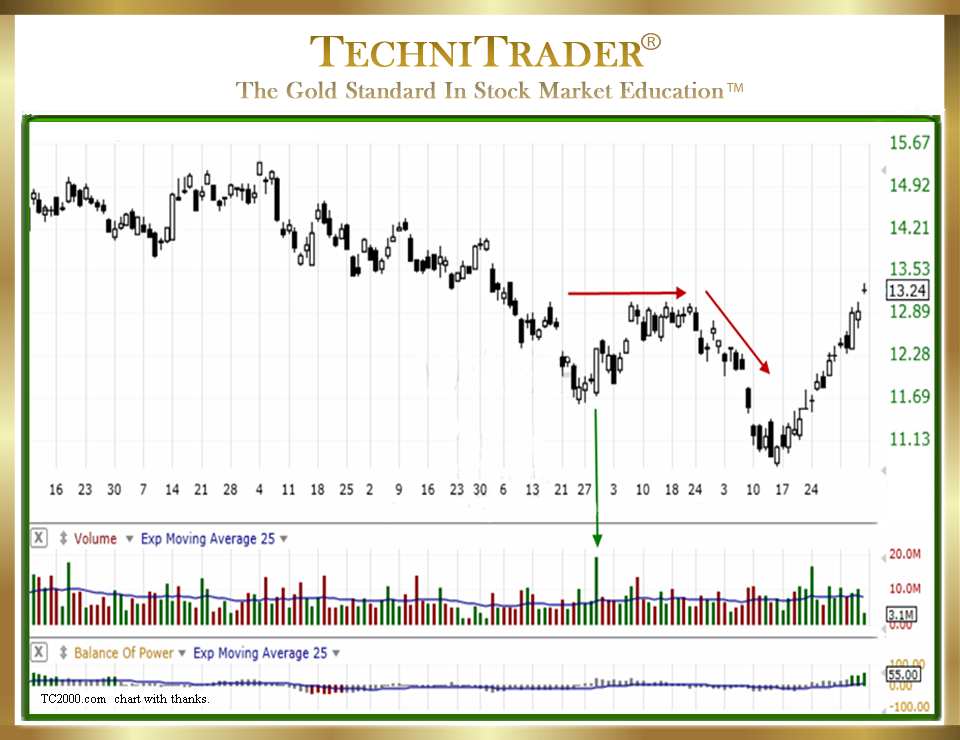
The chart example below shows High Frequency Trading high stock Volume spikes and long candlesticks. They attempted to drive price up as indicated by the green arrow, but the price quickly shifted sideways and then turned down again. The stock did not alter its trend. The second attempt tried to drive price down, which is the biggest black candlestick before the run up. However, the bottom for the Dark Pool Buy Zone™ had already been reached. The stock then commenced a sideways action of an early bottoming pattern.
LEARN MORE at TechniTrader.com
Most Individual Investors and Retail Traders do not need to worry about High Frequency Trading front-running stocks. If investments for your long-term portfolio are with a large to giant Mutual or Pension Fund, these funds are using Dark Pools which are off-the-exchange transactions. The High Frequency Traders (HFTs) cannot see the orders to front-run them.
If you are a Retail Trader, remember that most of the orders placed with online brokers for Retail Traders are filled from that broker’s inventory. So, those orders never make it to the exchanges. If you are using Electronic Communication Networks (ECNs), most of those orders are not sent to the exchanges either.
LEARN MORE at TechniTrader.com
Here is a list of 5 Causes of High Frequency Trading Front-Running Stocks:
- Study the TC2000.com Candlestick Chart example. The chart example above shows High Frequency Trading activity.
- Huge High Frequency Trading activity is usually a one-day event in a stock based on news, arbitrage from another market or instrument, or hedging.
- It is also caused by Cluster Orders from Retail Traders all using the same trading systems, strategies, MACD or Stochastic indicators, and some technical setups.
- One of the huge advantages a Retail Trader has using Technical Analysis and Candlestick Charts is the ability to see the activity of the High Frequency Traders, Dark Pools, Smaller Funds, Corporate Buybacks, and many more patterns that reveal who is controlling price and thus how price will behave thereafter.
- One final tip is that High Frequency Traders rarely shift the trend, so do not start Selling Short right after a huge High Frequency Trading down day.
Summary
Do not chase High Frequency Trading activity; instead, learn to enter before High Frequency Traders move price. Learn how to interpret Candlestick Charts and stock Volume action to know when Dark Pool Quiet Accumulation is occurring so you can buy into the stock before big High Frequency Trading moves.
The Individual Investor does not have the same access to information as the Mutual and Pension Fund Institutional Investors of the market, who control 80% of the market’s activity. So, the ability to read stock charts to uncover professional interest in a stock is key to successful investing and trading.
LEARN MORE at TechniTrader.com
If you have not yet begun to trade or invest, go to Introduction: Learn How to Trade Stocks – Free Video Lesson to get started.
Learn the steps to trade like a pro with this introductory mini course. You will learn what it takes to create a Professional Trading Plan that can help you achieve your trading goals: How to Create a Professional Trading Plan
Trade Wisely,
Martha Stokes CMT
TechniTrader technical analysis using a TC2000 chart, courtesy of Worden Bros.
Chartered Market Technician
Instructor & Developer of TechniTrader Stock & Option Courses
Copyright ©2015–2026 Decisions Unlimited, Inc. dba TechniTrader. All rights reserved.
TechniTrader is also a registered trademark of Decisions Unlimited, Inc.